Italy's eID Paradox: Advanced Stack, Analog Bottleneck [Analysis]
Last updated: August 1, 2026
Italy kept an EU identity deadline and legislated around it. Not because of bad technology - because of appointment slots.

Key takeaways
- Paper identity cards lost travel validity on August 3, 2026. There was no extension of the EU deadline.
- Domestic derogations cover contracts signed before August 3 indefinitely, and a defined list of services only until January 31, 2027.
- Decree-Law 108/2026 cleared Parliament on July 29, 2026.
- IT-Wallet reached 12 million activations in July 2026, up from 10.1 million in February.
- Activating IT-Wallet still requires SPID or a CIE with its PIN, and the PIN is handed over at a municipal office.
Italy Leads Europe on eID Adoption - The Numbers Say So
By most measures, Italy is ahead of every other EU member state on digital identity.
More than 63 million electronic ID cards (CIE) have been issued since 2016, of which around 54.5 million were valid and in circulation as of April 2026, against a population of 66 million. The national digital wallet - IT Wallet, built into the IO app by PagoPA - crossed 10 million activations in February 2026 and reached 12 million by July 2026, with 19.3 million documents loaded. The state committed EUR 102 million in total across 2024-2026 under Article 64-quater of the Digital Administration Code, of which EUR 69 million comes from the PNRR.
But the most telling indicator is actual usage.
According to SimilarWeb data, the IO app peaked at 7.9 million monthly active users across iOS and Android in March 2026 and stood at 7.2 million in June 2026 - up 37% year-on-year from 5.2 million in June 2025.
That is not a pilot. That is a national-scale eID deployment that works.

What App Usage Data Reveals About Italy's Digital Identity Rollout
The SimilarWeb data tells a more granular story about how the infrastructure is holding up in practice.
IT Wallet Launch: 72k Downloads in a Single Day
When IT Wallet opened to all Italian citizens on December 4, 2024, the IO app recorded 72,359 downloads on Google Play in a single day - its highest on record. Monthly active users on Android jumped 55% in December alone, from 3.5 million to 5.4 million.
MAU Growth: From Spike to Steady State
After the launch surge, MAU held firm and continued climbing. By March 2026 the combined figure across both stores reached 7.9 million. New installs settled at roughly 300,000-370,000 per month through early 2026 - not spectacular, but consistent.
Android Accounts for 86% of Active Users
In June 2026, Android accounted for 86% of monthly active users against iOS at 14%. This tracks Italy's broader device split and has practical consequences: the IT Wallet experience is primarily an Android story. Friction on Android is friction for most users.
Daily Stickiness: 9.1% DAU/MAU
The DAU/MAU ratio averaged 9.1% between October 2025 and June 2026. Social apps run above 50%; banking apps around 20-30%. For a government services app, 9% is reasonable - roughly one in eleven registered users opens it on any given day, which points to genuine utility rather than post-onboarding abandonment.
The data describes a digital identity product that genuinely works at scale.
CieID: The Card Is Universal, Its Digital Use Is Not
The gap between issuance and use is visible in a second app. CieID, which turns the physical CIE into a login credential, doubled its monthly active users in twelve months, from 2.7 million in June 2025 to 5.4 million in June 2026. That is real growth - and against roughly 54.5 million valid cards, it is still about one card in ten being used as a digital identity. Italy has near-universal coverage of the credential and single-digit-percentage coverage of the habit.
Why Italy Missed Its August 2026 Identity Card Deadline
On June 16, 2026, the Italian Council of Ministers approved a decree creating a domestic transition regime around the August 3 cutoff set by Council Regulation (EU) 2025/1208. The decree was published on June 26 as Decree-Law 108/2026. The Chamber approved the conversion bill on July 23 and the Senate on July 29, 2026.
The reason, stated plainly in the official release: municipalities were unable to process the remaining paper cards fast enough before summer.
The Interior Ministry had flagged the problem months earlier.
Registry offices reported a sharp spike in CIE renewal requests through spring 2026.
With the deadline falling in the middle of the Italian summer - when staff numbers drop and millions of citizens travel - the government concluded a crunch was unavoidable.
The decree is narrower than the initial coverage suggested. In any contract concluded by August 3, 2026 where a paper card was used to identify the parties, that card stays valid for identification until the date printed on it. Until January 31, 2027, an unexpired paper card can also be used to access healthcare, social security and insurance services, and in dealings with public administration, banks and post offices. Until December 31, 2027, mayors can issue a provisional paper identity document valid for a maximum of six months. Paper cards still lose their validity as travel documents on August 3 as scheduled.
This is not a story about Italy failing at digital identity.
It is a story about the gap between a working digital infrastructure and the physical layer that feeds it.

The Last-Mile Problem That eIDAS 2.0 and EUDI Wallet Cannot Fix Alone
The EUDI Wallet deadline is December 2026 for all 27 EU member states.
Most are well behind Italy.
And Italy - with over 63 million eIDs issued, a functioning national wallet, and years of sustained investment - still could not retire paper documents on schedule because local registry offices ran out of appointment slots.
The bottleneck was not the wallet.
It was not the chip.
It was not adoption.
It was the moment a citizen has to show up in person at a municipal office to get the credential that everything else depends on. No amount of API coverage, ARF compliance, or eIDAS 2.0 alignment closes that gap if the issuing infrastructure cannot keep pace.
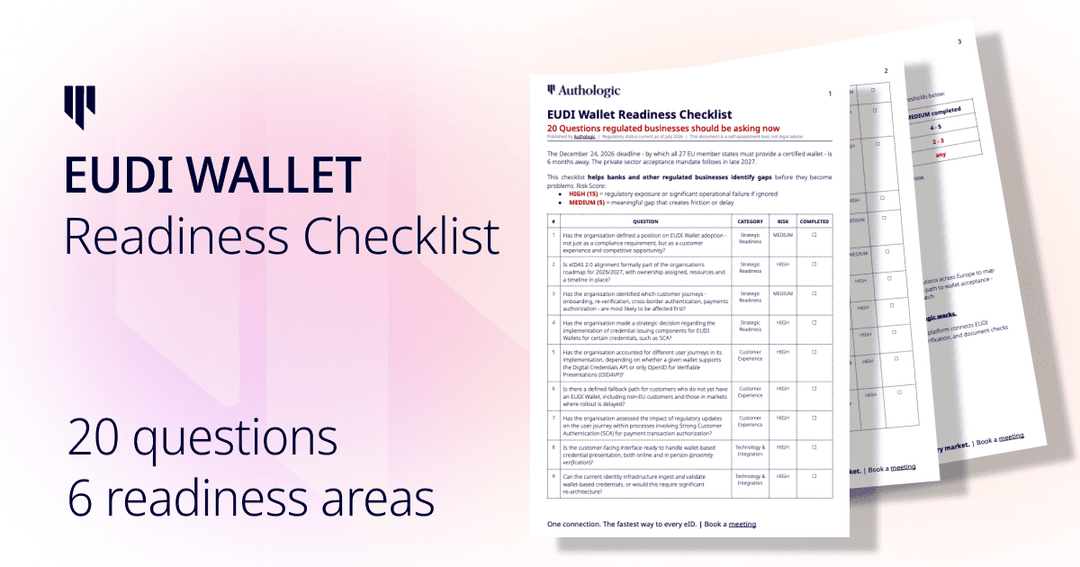
There is also an open question Italy shares with every other member state: the relationship between national wallets and the EUDI Wallet. Our EUDI Wallet Readiness Checklist covers the same question from the relying party's side: what you need in place regardless of which national wallet a customer presents.
IT Wallet was designed as a precursor to EUDI - built on compatible standards, open source, interoperable in principle.
But how and when it becomes a certified EUDI Wallet, or operates alongside one, is still unresolved.
That will matter as December 2026 approaches.
What the eIDAS 2.0 Transition Actually Means for KYC Compliance
For regulated businesses - fintechs, banks, gaming operators, telcos - the Italy situation is a useful reality check on what the eIDAS 2.0 transition looks like on the ground.
Italy is the best case.
Over 63 million eIDs issued, a wallet with 12 million activations and over 7 million monthly active users, EUR 102 million of public investment - and the country still could not fully retire paper documents on schedule.
Paper cards, CIE, SPID and IT Wallet will coexist in Italy for years.
Multiply that across 27 member states, each at a different stage, each with its own national eID scheme, and the fragmentation is structural - not a transitional blip.
The businesses that handle this well are not the ones rebuilding their verification flows every time a deadline shifts or a new wallet format enters the picture.
They are the ones running a single integration that covers every valid method in every market - and stays current as the landscape moves underneath them.
FAQ
Are Italian paper identity cards still valid after August 3, 2026?
Only for specific domestic purposes. An unexpired paper card remains usable for identification in contracts concluded before August 3, 2026, until the date printed on it. Until January 31, 2027 it can also be used to access healthcare, social security and insurance services, and in dealings with public administration, banks and post offices. It is not valid for travel abroad after August 3, 2026.
Which regulation sets the August 3, 2026 deadline?
Council Regulation (EU) 2025/1208 of June 12, 2025. It replaced Regulation (EU) 2019/1157, which the Court of Justice annulled in March 2024, and kept the original phase-out deadlines. It is not an eIDAS deadline.
How many people use IT-Wallet?
The Department for Digital Transformation reported 12 million activations in July 2026, up from 10.1 million in February 2026.
Is IT-Wallet an EUDI Wallet?
Not formally, yet. It was designed as a national precursor on compatible standards. Its guidelines and trial rules were approved by decree published on July 23, 2026, which also opened a national test environment to private wallet providers. Every member state must provide at least one certified EUDI Wallet by December 24, 2026.
What do you need to activate IT-Wallet?
An active digital identity: SPID, or a CIE with its PIN and an NFC-capable smartphone. The CIE itself cannot currently be stored in the wallet as a document.
When must regulated businesses accept the EUDI Wallet?
Private relying parties in the sectors listed in Article 5f of eIDAS 2.0 must accept the EUDI Wallet wherever Strong Customer Authentication is legally required, from December 24, 2027. The separate obligation on member states to make a wallet available falls on December 24, 2026. AMLR applies six months earlier, from July 10, 2027. Our SCA & AMLR Readiness Checklist maps both deadlines in 32 questions.
Not sure where your organisation stands on EUDI Wallet readiness?
Download 20 questions that help banks and other regulated businesses identify gaps before the December 2027 acceptance deadline.
App usage data in this article is sourced from SimilarWeb (data range June 2023 - June 2026, downloaded August 2026) and covers the IO app and CieID. SimilarWeb figures are estimates based on panel data and should be treated as directional indicators, not official statistics. Official activation figures (12M IT Wallet activations, July 2026) come from the Italian Department for Digital Transformation; CIE issuance figures from AgID. The August 3, 2026 deadline is set by Council Regulation (EU) 2025/1208; the domestic transition regime by Decree-Law 108/2026, Article 11.
Changelog
- August 1, 2026 - Updated the legal basis to Council Regulation (EU) 2025/1208, corrected the scope of the paper card derogation, added the parliamentary conversion of Decree-Law 108/2026, refreshed IT-Wallet and IO app figures to July and June 2026, added CieID usage data.
- June 18, 2026 - Initial publication.
Share article
Press Contacts
Dominika Cepek
dominika.cepek@authologic.comAuthologic
contact@authologic.com