The simplest way to implement the EUDI Wallet is the one you don't rebuild later
Last updated: August 6, 2026
For a business operating in more than one EU market, the simplest EUDI Wallet implementation is a single orchestration layer: one integration that covers all 27 national wallets and falls back to a national eID, a BankID or a document check when the wallet isn't available.
That is the model Authologic runs in production: EUDI Wallets verified alongside 91 identity methods across 84 providers in 236 countries and territories (as of August 2026) - 1 integration instead of 27.
A single-wallet integration is faster to ship in week one - but it's the version most teams rebuild within 18 months.
The context: by December 2027, EUDI Wallet acceptance becomes mandatory for banks, payment providers, telecoms and other regulated sectors across the EU. Compliance and engineering teams are asking the same question right now: what's the simplest way to implement it?
The honest answer depends on what "simple" means.
What does "simple" mean for an EUDI Wallet implementation?
Simple to ship - the rebuild-later implementation - means confirming compliance by shipping a solution that reads PID credentials, tested against one selected country's wallet, to hit a deadline. It's the fastest way to get something live. It's also the version most teams regret 18 months later, when a second market goes live, or a national wallet changes its verification flow or protocols, and the "simple" integration turns out to be a single point of failure with no fallback.

Simple to run - the eID-native implementation - means something different: one integration that keeps working as everything around it changes. The EUDI Wallet isn't one implementation - it's 27 national rollouts, each with its own timeline, its own verification flow, and its own edge cases, as Italy's rollout showed. A business operating in more than one EU market isn't choosing between "simple" and "complex." It's choosing between building 27 simple integrations, or one that handles all of them.

What does "simple to run" actually require?
3 things separate an EUDI integration that scales from one that doesn't:
A single API, regardless of country. The integration layer shouldn't change when a business expands from Poland to France. Especially early on, wallets will differ in protocol maturity and supported use cases. And the attribute sets within the identity credential itself will vary from country to country.
Fallback that isn't an afterthought. Wallet adoption varies by country and will keep varying for years. An implementation that only works when the EUDI Wallet works is a liability the day adoption dips, a verification flow changes, or a user simply doesn't have the wallet installed yet. Denmark's AltID launch is a live example: AltID doesn't replace the country's existing MitID system, it sits alongside it, so a bank now has to handle a customer presenting a MitID credential, an AltID wallet credential, a document scan, or nothing digital at all - in the same flow. Routing to a national eID, a BankID or a document check as a fallback shouldn't require separate code paths - it should be the same integration handling a different method.
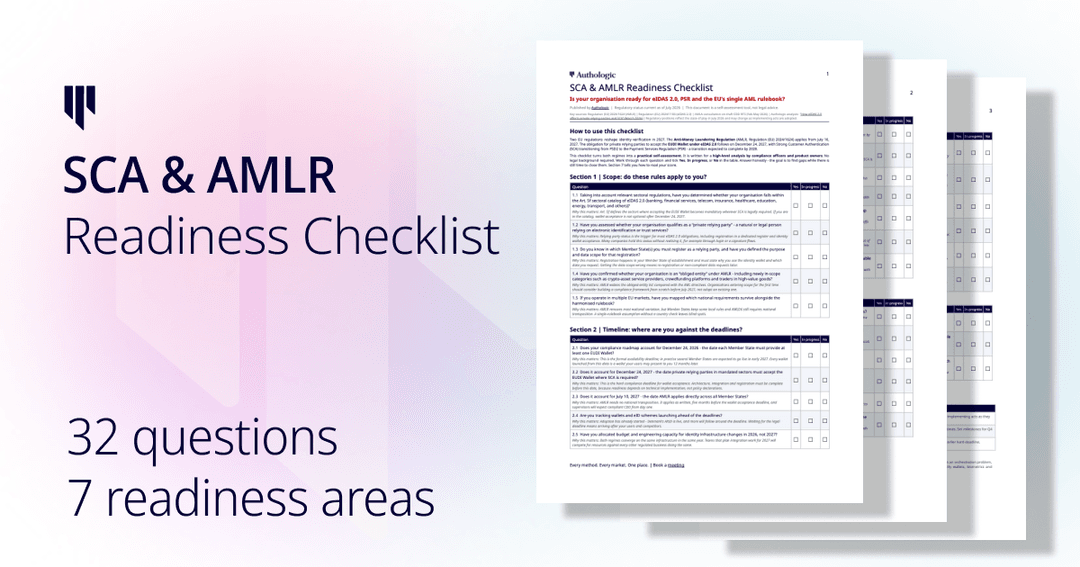
Room for what comes after the wallet. eIDAS 2.0 doesn't stand alone. AMLR applies from July 2027, replacing 27 national AML frameworks with one. An integration built only for wallet verification will need to be rebuilt for compliance checks; one built for identity orchestration already has the shape to extend. Our SCA & AMLR Readiness Checklist maps that second wave in 32 questions.
What's the trade-off between the two?
Here's what most "simple implementation" guides don't say out loud: a single-wallet integration is genuinely faster to ship in week one. The cost shows up later, at the moment a second market, a fallback scenario, or a compliance requirement forces a rebuild - usually against a deadline, not ahead of one.
Simple to ship | Simple to run | |
|---|---|---|
Integration effort, week 1 | Lower | Slightly higher |
Works when the wallet fails or isn't available | No - single point of failure | Yes - automatic fallback to eID, BankID or document check |
Works in a second EU market | Requires new interoperability tests, fulfilling missing attributes etc. | Same integration, different method |
Ready for AMLR (July 2027) | Requires a separate build | Same orchestration layer extends to it |
Cost of a national wallet changing protocols or supported data sets / credentials | Rebuild | Absorbed by the routing layer |
Total integrations for 27 member states | Up to 27 | 1 |
An orchestration layer costs slightly more integration effort up front, in exchange for not having that moment at all. Authologic connects the EUDI Wallet alongside national eIDs, government wallets and BankIDs through one API, so "simple" means simple once, not simple until the next country.
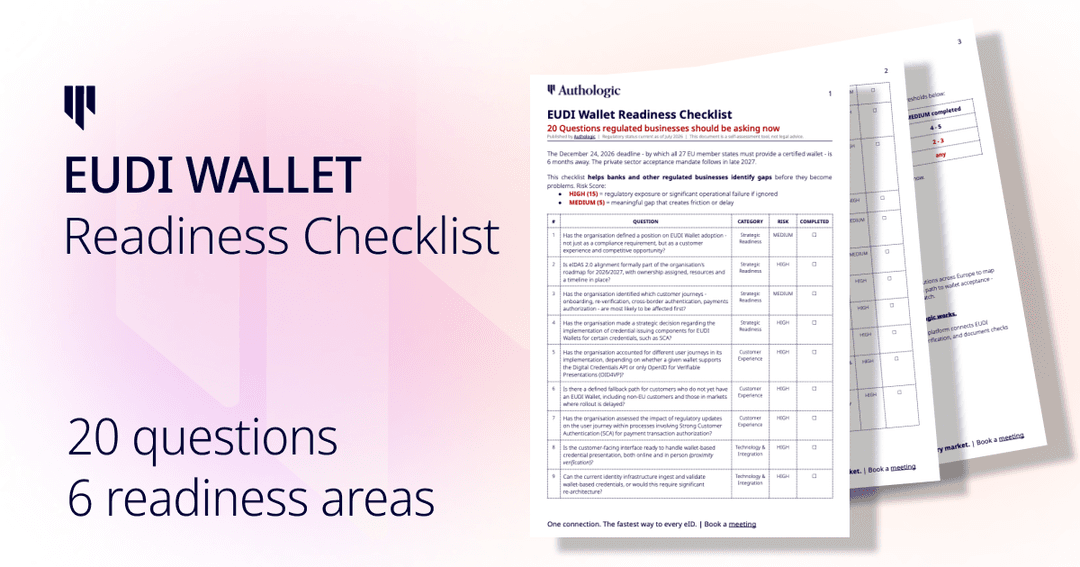
Our EUDI Wallet Readiness Checklist walks through what that looks like in practice - including questions like these:
Readiness area | Question from the checklist |
|---|---|
Orchestration & Fallback | Does the architecture support the case where wallet authentication fails - due to reasons such as credential expiration? Has a fallback sequence been defined for this scenario? |
Orchestration & Fallback | Does the architecture support intelligent routing: selecting the most appropriate identity method based on customer context, jurisdiction, assurance level, and wallet credentials availability? |
Compliance & Risk | Has the compliance team assessed how wallet-based PID (Person Identification Data) maps to existing KYC and AML requirements, including standards under AMLR and EBA guidelines? |
These are 3 of the 20 questions in the full checklist, spanning Strategic Readiness, Customer Experience, Technology & Integration, Orchestration & Fallback, Compliance & Risk, and Future Scalability - with a scoring guide to flag whether an organisation is Operationally Ready, In Progress, or Not Ready.
The real question
"What's the simplest way to implement the EUDI Wallet" is the wrong question if you operate in more than one EU market.
The better one: what's the simplest way to be ready for all 27 - and everything eIDAS 2.0 brings after them?
FAQ: EUDI Wallet implementation
How many EU countries need a certified EUDI Wallet, and by when?
All 27 EU member states are required to provide a certified EUDI Wallet by December 24, 2026. The separate mandate requiring banks, payment providers, telecoms and other regulated businesses to accept it follows by December 2027.
Is single-country EUDI Wallet support enough?
No - if you belong to a sector mandated to comply with eIDAS 2.0 regulations, you must be prepared for any EU citizen to walk in and use their national wallet. Individual wallets may differ in supported protocols - and consequently in supported use cases and credentials - as well as in the specific attribute sets contained within those credentials.
What happens if a customer doesn't have the EUDI Wallet yet?
Wallet adoption will vary by country for years after the 2026 rollout deadline. An implementation needs a defined fallback - routing to a national eID, a BankID or a document check - for customers who don't yet have a wallet, rather than treating the wallet as the only path.
Does an EUDI Wallet integration also cover AMLR compliance?
Not automatically. AMLR applies from July 2027 and covers anti-money-laundering checks, which is a separate requirement from identity verification. An integration built specifically and only for wallet verification will likely need additional work to extend into AMLR-driven compliance checks. For a dedicated self-assessment covering both regimes, see the SCA & AMLR Readiness Checklist.
Changelog
- August 6, 2026 - Added production coverage figures and named the two implementation approaches.
- July 29, 2026 - Added links to the SCA & AMLR Readiness Checklist.
- July 23, 2026 - Initial publication.
Share article
Press Contacts
Dominika Cepek
dominika.cepek@authologic.comAuthologic
contact@authologic.com