Dominika Cepek
Authologic vs Signicat | Identity verification comparison
Last updated: 16 October 2026
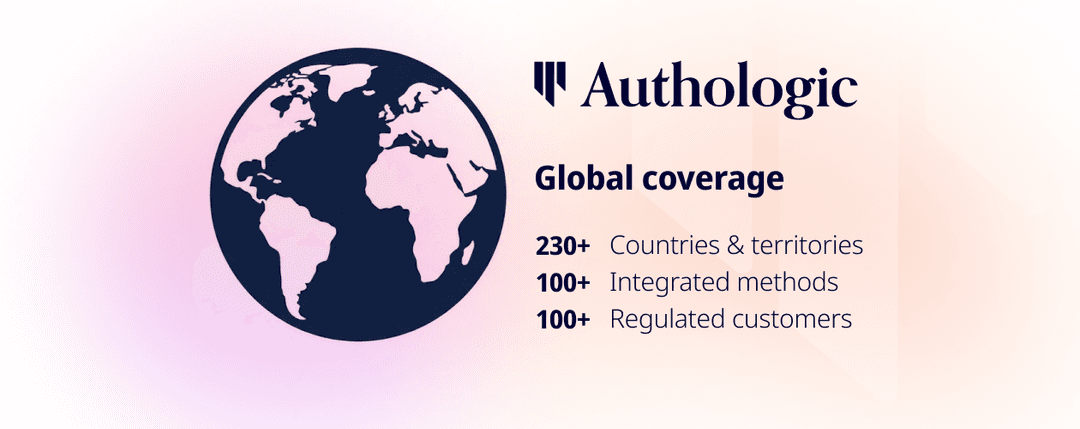
Authologic and Signicat both serve regulated businesses, but they are built for different core needs. Signicat is a European digital identity platform with electronic signing at its core, offering 35 European eIDs and its own qualified trust services. Authologic is the trust infrastructure platform shaping the future of digital identity. It offers 100+ identity methods across 230+ countries and territories and routes each user to an eID, bank ID or wallet before a document check. Signicat fits in-house qualified signing; Authologic fits eID and wallet verification in Europe and beyond.
Key takeaways
- Coverage: Authologic offers 100+ identity methods across 230+ countries and territories; Signicat lists 35 European eIDs (as of October 2026).
- Inside Europe: Poland’s mObywatel, used by more than 12 million people, is not among Signicat’s publicly listed methods.
- Orchestration: at Authologic, routing and fallback are configured for each customer and switched by Authologic’s team when a provider fails; in Signicat Mint, the customer builds and maintains the workflows.
- Signatures: Signicat operates its own qualified trust service provider (QTSP); Authologic provides QES through a certified partner and is building support for QES within the EUDI Wallet ecosystem.
- Source of funds: Authologic derives it from open banking data in 30 countries in the same API as identity; Signicat’s Open Banking Hub covers account verification and affordability checks in 22 countries.
Authologic vs Signicat at a glance
Capability | Authologic | Signicat |
|---|---|---|
eID and identity methods | 100+ identity methods across 230+ countries and territories, including national eIDs, bank IDs and government wallets | 35 European eIDs through its eID and Wallet Hub |
eID methods outside Europe | Yes: government-backed eIDs and wallets in markets beyond the EU | Not documented publicly; documented options outside Europe are document and biometric verification |
Wallet support | EUDI Wallets and European eIDs, plus Apple, Google and Samsung Wallet credentials (incl. Google ID Pass) | EUDI Wallets and European eIDs; Apple, Google and Samsung Wallet credentials not documented publicly |
Biometric and document verification | Orchestrates multiple specialist providers: liveness and OCR supporting 16,000+ identity document types, used as fallback rather than the default path | Own VideoID engine and ID document and biometric verification |
Orchestration model | Routing and fallback configured for each customer, through one integration | Signicat Mint: no-code workflow builder; the customer designs and maintains routing logic |
Open banking | 30 countries, 2,500+ banks; source of funds and source of wealth in the same API | Open Banking Hub: account verification and affordability checks, 22 countries |
Source of funds / wealth | Derived from open banking data, same API as identity | Available within onboarding flows |
Qualified electronic signatures (QES) | Through a certified partner; QES within the EUDI Wallet ecosystem in development | In-house QTSP: SES, AES, QES and eSeal; plans to register as a QTSP for QEAA |
Trust service status | Registered non-qualified trust service provider issuing electronic attestations of attributes | Qualified trust service provider (QTSP) |
API architecture | Single REST API - products designed to be combined, not integrated separately | Separate per-product APIs (eID Hub, Authentication, Mint and others) |
Figures for Signicat come from its public website and developer documentation, checked in October 2026.
Which should you choose?
Choose Signicat if:
- Qualified electronic signing outside the EUDI Wallet is your core need - contracts, eSeal and QES from a provider operating its own Qualified Trust Service Provider (QTSP)
- You want your own team to design and maintain verification workflows in a no-code builder
Choose Authologic if:
- eID and wallet-based verification is your core need - in Europe, beyond it, or both, across all three generations of digital identity
- You need source of funds and source of wealth from open banking in the same integration as identity verification
- You want to prepare for wallet-based QES - eIDAS 2.0 requires EUDI Wallets to provide qualified electronic signatures free of charge for non-professional use, and Authologic is building support for QES within the wallet ecosystem
If you are earlier in your evaluation and still mapping requirements, start with our KYC buyer’s guide, which walks through how to assess verification providers step by step.
What is Signicat?
Signicat is a European provider of digital identity and electronic trust services, offering identity verification, authentication, electronic signatures and orchestration tools. Founded in 2006 and headquartered in Trondheim, Norway, it operates across Europe and, according to its official company information, is trusted by over 20,000 organisations in financial services, the public sector and other regulated industries.
Signicat operates as a Qualified Trust Service Provider (QTSP) under eIDAS and describes itself as one of the first certified QTSPs under eIDAS 2.0. Qualified status means Signicat has passed the conformity assessment required to issue qualified electronic signatures, which carry the legal effect of a handwritten signature across the EU.
The EUDI Wallet scheme is an ambitious push toward digitisation across Europe, and Signicat has positioned its eID and Wallet Hub as a bridge through what its Head of Authentication and Wallets described as an “organised chaos” - businesses legally required to accept a new wallet most of their customers don’t have yet, while supporting the national and banking ID systems those customers use today.
What is Authologic?
Authologic is the trust infrastructure platform shaping the future of digital identity. Regulated businesses rely on Authologic to identify, onboard and authenticate their customers in 230+ countries and territories, using the best method available, at the lowest cost and with the least friction.
Offering 100+ identity methods, Authologic is the only platform that orchestrates three generations of identity: legacy documents and biometrics; national eIDs and bank IDs; and digital wallet cryptographic proof through its proprietary EUDI infrastructure.
Founded in 2020, Authologic is headquartered in Warsaw, with offices in London and San Francisco. Backed by Series A funding from OpenOcean, Y Combinator, Peak Capital and SMOK Ventures, Authologic serves 100+ regulated customers including OKX, eToro and Santander.
The founding premise is that document scanning should be the infrastructure of last resort, not the default path. Where a government-backed eID or wallet is available, using it instead of document capture can reduce friction, limit exposure to document fraud and shorten the onboarding process.
Authologic’s OmniID platform connects businesses to multiple identity verification methods through one integration. Routing and fallback are configured for each customer, so each user is offered a method that works in their market and on their device, with options such as document verification where digital credentials are unavailable.
The approach is already in production across regulated industries: mBank Group’s mElements runs B2B merchant onboarding on it, Intrum uses it for self-service identity checks, lender WEALTHON cuts document fraud with it, and mobility operator 4Mobility verifies renters through it.
In July 2026, Authologic partnered with Google, enabling businesses to accept identity credentials stored in Google Wallet - including Google ID Pass, available in the United States, United Kingdom, Brazil, Singapore and Taiwan. When a business requests verification, the user shares only the attributes needed, such as name or age confirmation, directly from their device.
What do the eIDAS 2.0 deadlines mean for this choice?
One in five client onboarding applications is abandoned due to KYC and AML challenges, costing banks an estimated $3.3 billion annually in lost business. Document-based verification can contribute to that friction by requiring users to photograph physical documents and complete additional checks. Meanwhile, governments are issuing reusable credentials directly to mobile devices, and eIDAS 2.0 sets fixed dates for when regulated businesses must accept them.
eIDAS 2.0 requires every EU Member State to make at least one EUDI Wallet available to all citizens and residents by December 2026 (Article 5a). From December 2027, private relying parties that are required to use strong user authentication for online identification, including banks and financial services, must accept the wallet when a user chooses it (Article 5f(2)). The obligation is not satisfied by accepting other forms of digital identity.
The scale is continental: roughly 450 million EU citizens and residents will be offered a digital identity wallet. For organisations in financial services, healthcare, telecommunications and the public sector, the practical consequence is the same: verification infrastructure that can process credentials issued in any Member State.
July 2027 brings the AMLR. Article 22(6) recognises two routes for verifying a customer’s identity: identity documents together with reliable and independent sources, or electronic identification means at substantial or high assurance together with relevant qualified trust services. AMLA sent its draft technical standards on customer due diligence to the European Commission on 1 October 2026; what the draft changes for remote verification is explained separately. Whether every wallet will be ready for every use case on day one remains an open question - the legal obligation to accept them does not.
Authologic is built for this transition. The question is what happens to your users who aren’t EU citizens, and to the many EU users who won’t have a wallet for some time after the December 2026 issuance deadline.
Every one of those users needs a fallback. What that fallback is - a high-assurance eID, or a document scan - determines your actual conversion rate. The EUDI Wallet Readiness Checklist turns these obligations into steps.
How do Authologic and Signicat compare on eID coverage?
Authologic’s eID coverage is global, Signicat’s is European, and the difference shows inside Europe too.
With Signicat, businesses get access to 35 European eIDs through a single integration - BankID, MitID, itsme and Smart-ID among them. But 35 eIDs is not full European coverage: government wallets such as Poland’s mObywatel, used by more than 12 million people, are not among Signicat’s publicly listed methods (as of October 2026). Even inside Europe, a coverage gap means a document-scan fallback.
Authologic offers 100+ identity methods across 230+ countries and territories, including government-backed identity systems in markets far beyond the EU. The gap matters the moment you have users outside Europe, or users inside Europe who don’t have a Signicat-supported eID.
For a non-EU user, or an EU user whose eID isn’t among Signicat’s 35 European eIDs, a Signicat flow falls back to a document scan. An Authologic flow routes the user to the best local eID or government wallet available and holds document scanning in reserve.
The coverage difference can affect conversion. Signicat’s own Battle to Onboard research found that abandonment of financial services onboarding rose from 40% in 2016 to 68% in 2022, with identity verification contributing to friction in the onboarding process. Government-backed eIDs can offer shorter flows and fewer user actions than document-based verification, particularly in markets where eID adoption is already high. Plenti, a Polish subscription rental company, made mObywatel its main identity path: about 87% of its customers now verify with it, and verification costs fell by 37%.
For a real-world example of what this looks like for a telecom operator verifying subscribers of every nationality, see the FONIA case study.

How do Authologic and Signicat approach identity orchestration?
The main orchestration difference between Authologic and Signicat is who builds and maintains the routing.
Integrating regional eIDs one by one creates fragmented workflows, vendor lock-in and compounding technical debt. Every new market means another integration to build, certify, monitor and maintain. Authologic and Signicat both solve this problem, but from different starting points.
Authologic is built as an orchestration layer by design. One integration routes each user to a local eID or wallet available in their market, and routing and fallback are configured for each customer. When a provider becomes unavailable, Authologic’s team switches traffic without any change on the customer’s side, as described in what happens when an identity verification provider goes down.
Signicat approaches orchestration through Signicat Mint, a no-code platform that allows businesses to create and manage their own verification workflows without extensive programming knowledge.
Signicat’s developer documentation reflects the same structure: separate APIs per product, with authentication protocols - OIDC, SAML and its own Authentication REST API - documented separately. Authologic exposes one REST API across all products, so adding a method or a market later is a configuration change, not another integration project.
The practical question for your engineering team: when your verification logic needs to change because a country launches a new eID scheme, who does the work - you, or the platform?
How do Authologic and Signicat handle open banking and source of funds?
Authologic includes source of funds and source of wealth verification derived directly from open banking transaction data, covering 30 countries and 2,500+ banks. Source of funds and source of wealth come bundled with identity verification in the same API, rather than requiring a separate integration.
Signicat’s Open Banking Hub, launched in October 2024, focuses on bank account verification and affordability checks across 22 countries. Risk-related data collection, including source of funds and wealth information, is available within its onboarding solutions.
For businesses subject to AML source-of-funds obligations - iGaming operators under affordability requirements, wealth managers, crypto platforms - the architectural question is the same one that runs through this entire comparison: one integration or several? How other identity platforms handle screening and source of funds is compared in Best AML and KYC identity verification platforms.
Where is Signicat stronger? Qualified electronic signatures
Signicat is a Qualified Trust Service Provider (QTSP) for standalone qualified electronic signatures (QES) and, according to its EUDI Wallet FAQ updated in May 2026, will register as a QTSP for qualified electronic attestations of attributes (QEAA) under eIDAS 2.0. Operating a QTSP means passing an independent conformity assessment against ETSI standards and holding legal liability for the qualified services it provides.
Authologic provides QES through a certified partner. Authologic itself is a registered non-qualified trust service provider issuing electronic attestations of attributes, and does not operate its own QTSP. If qualified electronic signing at scale - contracts, regulated agreements, notarised documents - is central to your use case, Signicat is the stronger choice on this specific capability.
QES has historically been a paid trust service. eIDAS 2.0 changes those economics: Article 5a requires EUDI Wallets to provide qualified electronic signatures free of charge for non-professional use. Jon Ølnes, who leads signing and trust services at Signicat, has publicly questioned the wallet’s economics, warning in April 2025 that “without viable payment mechanisms, the system risks relying entirely on government funding”, and in October 2025 that every component of the wallet ecosystem needs “a sustainable business model”. Authologic carries no legacy signing revenue - for an orchestration platform, free wallet-based QES is upside, not disruption.
If you need established, standalone QES infrastructure today, Signicat has two decades of it. If you want QES the way eIDAS 2.0 is redefining it - free of charge for citizens within the EUDI Wallet - Authologic is building support for qualified signatures inside the wallet ecosystem, alongside its global eID coverage.
Which is better for iGaming operators?
In iGaming, the method matters as much as the check itself. For operators active across multiple regulated markets, three problems make identity verification harder than it looks from the outside.
Fragmented regulation. Every market mandates different identity standards, different acceptable methods, and different obligations for operators. A provider limited to European eIDs forces document-based workarounds the moment you expand - and document-based workarounds face growing scrutiny as AI-generated fraud scales.
Multi-accounting and bonus abuse. This is the one that costs operators the most money and gets the least technical attention. Document checks alone cannot prevent a player from registering twice. Government-backed eIDs bind verification to a real, unique individual at the national identity level, so an operator can detect a second registration by the same person. An eID-first approach doesn’t just support compliance; it addresses one of iGaming’s most expensive operational problems at the infrastructure layer, before any manual review process begins.
Tightening compliance stacks. PEP and sanctions screening, affordability checks, source of funds verification and responsible gambling measures increasingly need to coexist in a single onboarding flow. Authologic’s iGaming customers include STS, LVBet, Betfan and Superbet. LVBet - operating in Poland and Latvia - replaced OCR-only document verification with eIDs including mObywatel, mojeID, Smart-ID and eParaksts, accessed through a single API.
How are Authologic and Signicat priced?
Both companies price on request, based on verification volume, methods used and markets covered.
FAQ: Authologic vs Signicat
What is the main difference between Authologic and Signicat?
Category and coverage. Authologic is the trust infrastructure platform covering all three generations of identity, with 100+ identity methods across 230+ countries and territories. Signicat is a European digital identity platform with electronic signing at its core. On qualified signatures the models differ: Signicat operates its own QTSP with a full QES suite built as a paid trust service, while Authologic offers QES through a certified partner and is building support for QES within the EUDI Wallet ecosystem, where eIDAS 2.0 makes qualified signatures free of charge for non-professional use.
Is Authologic a good alternative to Signicat?
Yes - for eID and wallet-based verification in Europe and beyond. Authologic offers 100+ identity methods across 230+ countries and territories, including European methods absent from Signicat’s 35 European eIDs, such as Poland’s mObywatel (as of October 2026), and adds method fallback configured for each customer and source of funds verification. For businesses whose core requirement is in-house qualified electronic signatures from a QTSP, Signicat is the stronger choice on that specific capability.
Does Signicat support eID verification outside Europe?
Signicat’s eID and Wallet Hub covers 35 European eIDs. For users outside Europe, Signicat’s documented options are document and biometric verification. For eID-based verification in non-EU markets, a provider with global eID coverage is required.
Can Authologic handle EUDI Wallets?
Yes. OmniID connects businesses to Google Wallet, government eIDs, EUDI Wallets, mobile driving licences, bank-based verification and biometric checks through a single integration, with fallback configured for each customer when a user’s device or location means the preferred method isn’t available.
Does Authologic offer qualified electronic signatures (QES)?
Yes, through a certified partner, and Authologic is building support for QES within the EUDI Wallet ecosystem, where eIDAS 2.0 makes qualified signatures free of charge for non-professional use. Authologic is a registered non-qualified trust service provider issuing electronic attestations of attributes and does not operate its own QTSP. If established, standalone QES infrastructure is a hard requirement today, Signicat has the edge on that specific capability.
Can I verify the source of funds with Authologic or Signicat?
Authologic derives source of funds and source of wealth directly from open banking data across 30 countries and 2,500+ banks, bundled with identity verification in the same API. Signicat’s Open Banking Hub covers bank account verification and affordability checks in 22 countries, with risk data collection available in its onboarding flows.
Which provider is better for iGaming compliance?
Authologic fits multi-market iGaming operators better: global eID coverage handles fragmented regulations, government-backed eIDs help operators detect multi-accounting, and built-in source of funds checks support affordability requirements. Operators using it include STS, LVBet, Betfan and Superbet.
What does the eIDAS 2.0 deadline actually mean for my business?
From December 2027, private relying parties required to use strong user authentication for online identification, including banks and financial services, must accept EUDI Wallets when a user chooses them. The obligation is not satisfied by accepting other forms of digital identity. Authologic supports EUDI Wallets and is building support for QES within the wallet ecosystem. The decision between the two providers is about what you need beyond the EUDI Wallet: global eID coverage and orchestration, or in-house qualified signing infrastructure.
Changelog
- 16 October 2026 - Updated the Authologic description and company figures, Signicat data (checked October 2026), the orchestration description, and the eIDAS 2.0 and AMLR context, including AMLA’s draft standards on customer due diligence. The capability graphic was replaced by rows in the comparison table. Added internal links.
- 28 July 2026 - Updated positioning, expanded the QES section with EUDI Wallet economics, refined recommendation criteria.
- 17 July 2026 - Initial publication.
Share article
Press Contacts
Dominika Cepek
dominika.cepek@authologic.comAuthologic
contact@authologic.com