Denmark launches AltID | What one of Europe's first live EUDI Wallets means for banks
Last updated: August 1, 2026
On June 3, 2026, Denmark launched AltID - one of the first official digital identity wallets in the EU.
Available on iOS and Android for anyone over 13 with a MitID account and a Danish CPR number, it stores a digital ID card and an age certificate locally on the device. No centralised database. No usage tracking. Zero-knowledge proofs for age verification - users confirm they meet an age threshold without revealing their date of birth or national ID number.
It is a quiet launch. No fanfare. Just an app in the store, backed by a government agency. And that is exactly why it matters.
Key takeaways
- AltID passed 230,000 downloads by July 23, 2026, seven weeks after launch, according to the Danish Agency for Digital Government.
- The health insurance card is next, expected in months rather than years. The driving licence follows.
- AltID is live but not yet certified. Its relying party registry is a national one, not an eIDAS 2.0 registry.
- Denmark remains in the top readiness tier across independent EUDI trackers. Most member states are not.
- AltID is not replacing MitID. MitID has 5.5 million registered users and flat year-on-year app usage. The two will coexist.
- For banks, the acceptance obligation lands December 24, 2027. The wallet availability deadline for member states is December 24, 2026.
From EUDI Policy to Live Infrastructure: Why AltID Matters
For the past 3 years, EUDI Wallet has been a regulatory project. Frameworks, working groups, reference implementations, pilot programmes.
The December 24, 2026 deadline - by which all 27 EU member states must make at least one certified wallet available to citizens - has felt distant enough to treat as someone else's problem.
The December 24, 2026 deadline - by which all 27 EU member states must make at least one certified wallet available to citizens - has felt distant enough to treat as someone else's problem.
AltID changes that framing.
Denmark has positioned AltID as its national EUDI Wallet implementation, confirmed by the Danish Agency for Digital Government - the designated competent authority for eIDAS 2.0 in Denmark.

The agency is rolling out AltID in phases, on a 3-5 year roadmap of expanding credentials and functionality. Formal certification is still ahead, but the infrastructure is live and the intent is official. Independent trackers place Denmark in the top readiness tier, while noting that the current AltID relying party registry is a national one rather than an eIDAS 2.0 registry. Live and certified are not the same thing, and the gap between them is where most of the remaining work sits.
With the deadline now 6 months away, the picture across Europe is uneven. Italy shows the other side of that unevenness: the most advanced eID base in Europe, and still a paper document transition it could not complete on schedule.
The European Commission has signalled that only a limited number of member states are likely to meet it. The Netherlands has publicly acknowledged it will not deliver full functionality in time. Others are still in pilot mode.
What Denmark has done - put working infrastructure in citizens' hands ahead of certification - puts it ahead of most.
Seven Weeks In: What AltID Adoption Data Shows
On July 23, 2026, the Danish Agency for Digital Government reported that more than 230,000 people had downloaded AltID. Set against MitID's 5.5 million registered users, that is roughly 4% of the base - early-stage adoption rather than mass adoption, but real usage of a live national wallet, which is more than most member states can currently point to.

The comparison is worth holding onto. The MitID app averaged 3.3 million monthly active users in June 2026, a figure that has moved less than 1% year on year. That is a mature product at its ceiling. AltID, seven weeks old, sits at about 7% of that. Denmark is not migrating from one to the other; it is running both, and will be for years.
Third-party estimates from SimilarWeb, covering mid-June to the end of July, add texture to the AltID headline.
Through the first half of July, downloads ran at a median of roughly 2,100 per day, then fell to under 1,000 between July 14 and 23, consistent with the Danish summer holiday period.
The clearest signal came at the end of the month. Two days after the agency published its download figures and confirmed that the health insurance card was being added, AltID recorded its highest single day in the series - 7,761 downloads on Saturday July 25, followed by 6,616 on the Sunday. Across that weekend the app was downloaded roughly 14,000 times, against a median of under 1,000 per day in the preceding week and a half.
A government press release about adding a health card generated more installs in 48 hours than the preceding ten days combined.
That is worth noting for anyone planning a wallet rollout. Adoption here did not track the launch. It tracked the moment citizens learned the wallet would hold something they use regularly. The credential drives the download, not the wallet.
What the AltID Launch Means for Banks and Financial Institutions
The wallet acceptance mandate follows the rollout mandate.
By December 24, 2027, banks, telecoms, and large online platforms operating in the EU must accept EUDI Wallets as a primary authentication method. That window is shorter than it looks when you factor in the procurement cycles, compliance reviews, and technical integrations that financial institutions require.
The AltID launch surfaces 3 practical questions that banks can no longer defer.
I. Onboarding Design and the MitID Coexistence Reality
When a customer presents a wallet credential instead of a document scan, the onboarding flow changes - the data format, assurance level, and consent model are all different.
Banks that have not yet mapped this journey need to start. Denmark illustrates why this is more complex than it looks.
MitID, the country's existing national eID, has more than 5.5 million registered users, with over 96% of Danes aged 15 and above holding an active MitID. The MitID app alone averaged 3.3 million monthly and 2.4 million weekly active users in June 2026, with a daily-to-monthly ratio of 23% - the usage profile of infrastructure people touch several times a week, not an app they installed and forgot. But MitID is an authentication tool, not a document wallet - it confirms who you are and grants access to services, but does not store credentials on the device.
AltID adds that layer: local storage of identity credentials with selective disclosure via zero-knowledge proofs.
AltID does not replace MitID.
AltID | MitID | |
|---|---|---|
Type | Credential wallet | Authentication tool |
Launched | June 2026 | 2021 |
Reach | 230,000 downloads | 5.5 million registered users |
App monthly active users | Not published | 3.3 million |
Year-on-year app growth | 7 weeks old | +0.9% |
Stores credentials on device | Yes | No |
Required to set up the other | No | Yes - AltID requires MitID |
AltID downloads: Danish Agency for Digital Government, July 2026. MitID app usage: SimilarWeb, June 2026.
It extends the Danish digital identity ecosystem - and the Danish Agency for Digital Government has confirmed a 3-5 year roadmap for adding further credentials and functionality to AltID over time.
What launched on June 3 is the foundation, not the finished product.
For banks, the practical implication is that a customer onboarding today might present a MitID credential, an AltID wallet credential, a document scan, or nothing digital at all.
Each path requires different handling.
Routing between them intelligently - based on what the customer has, what the use case requires, and what compliance demands - is the central design challenge of the EUDI transition period.
What Lands in AltID Next
The agency has been specific about sequencing. The yellow health insurance card is in active development, described by the head of its eID and apps division as a matter of months rather than years. The driving licence is planned after that. Discussions are open with the education sector on diplomas and exam certificates, and with the police on criminal record certificates, though nothing there is decided.
For banks the relevant point is not any single credential. It is that the attribute set inside a national wallet expands on a government timeline, not a procurement one. An integration built around today's two credentials - an ID card and an age proof - will encounter a materially different payload within a year.
II. Cross-Border Interoperability and Wallet Acceptance
AltID is designed to work across EU borders - a Danish wallet credential should, in principle, be accepted at a German bank or a Dutch fintech.
In practice, cross-border trust infrastructure and mutual recognition frameworks are still being finalised.
Banks operating across multiple markets need to monitor this closely and avoid building integrations that assume a single-country scope.
III. KYC, AML, and the Expanding Scope of Wallet Attributes
The compliance implications of EUDI Wallets go well beyond identity verification at onboarding.
The first wave of wallets, including AltID, focuses on identity - confirming who the customer is with a high-assurance credential. But identity is only the first step.

Over the coming months, wallets will begin carrying additional attributes.
For more sophisticated product lines - savings accounts, lending, investment products - banks will need to process attestations covering tax residency, income verification, and credit-relevant data directly from wallet credentials.
The compliance and data handling implications need to be mapped before those attributes arrive.
The longer-term shift is more structural still.
Banks are mandated to transform their transaction authorisation frameworks by incorporating Strong Customer Authentication (SCA) attestations directly from the wallet - moving SCA from bank-controlled flows to wallet-native attestations. The SCA & AMLR Readiness Checklist maps both regimes in 32 questions.
This has the potential to fundamentally reshape how payment transactions are authorised under PSD2 and its successors.
How Authologic Helps Banks Prepare Without Rebuilding Their Stack
The biggest barrier to EUDI readiness in the financial sector is not a lack of willingness. It is a lack of awareness.
Financial institutions are operating under an unprecedented volume of regulatory change. AMLR, CCD2, PSD3, DORA - the pipeline is relentless.
In that environment, eIDAS 2.0 and the EUDI Wallet mandate have quietly slipped off the radar for many compliance and technology teams.
Banks are realising very late that they have a hard obligation to implement - not just an option to explore.
This is where subject-matter expertise matters as much as technology.
Knowing which mandates apply, in which markets, on which timelines - and how they interact with existing compliance frameworks - is not something most banks can map internally at speed.
The core technical challenge compounds this.
It is not wallet acceptance in isolation - it is orchestration: handling wallet credentials alongside national eIDs, bank-based identity verification, biometrics, and document checks within a single onboarding flow, across multiple markets, without rebuilding compliance processes and identity flows every time a new wallet scheme or regulatory requirement goes live.
Authologic connects all of these paths through a single API.
Danish banks looking to accept AltID credentials today - and stay ready for every subsequent wallet rollout across Europe - can do so without managing country-by-country integrations.
The orchestration layer handles routing, fallback logic, and compliance requirements regardless of which identity method the customer presents.
Wallet-ready, without being wallet-dependent.
The Cost of Waiting

The regulated sectors most exposed to the 2027 mandate - banking, financial services, telecoms - are also the sectors with the longest implementation lead times.
Organisations that start now are not just preparing for a compliance deadline.
They are building early experience with credential-based identity verification, which is structurally different from document-based verification and has compounding value: better conversion rates, lower fraud exposure, and readiness to extend to new markets as national wallets roll out.
Denmark is one country. But it is an early, concrete signal of what the next 12 to 18 months look like across the continent.
The question is not whether EUDI Wallets are coming.
It is whether your organisation is ready to accept them when they arrive.
FAQ
What is AltID?
AltID is Denmark's official digital identity app, launched on June 3, 2026 by the Danish Agency for Digital Government. It is available to anyone aged 13 or over with a Danish CPR number and a MitID account. The first version holds a digital ID card and an age credential, both stored locally on the device.
How many people use AltID?
More than 230,000 downloads as of July 23, 2026, according to the Danish Agency for Digital Government. The agency deliberately collects very limited usage data, so download counts are the main published metric.
Is AltID a certified EUDI Wallet?
Not yet. Denmark has positioned AltID as its national EUDI Wallet implementation, and the infrastructure is live, but formal certification is still ahead. The current AltID relying party registry is a national registry rather than an eIDAS 2.0 one. Every member state must make at least one certified wallet available by December 24, 2026.
Does AltID replace MitID?
No. MitID is an authentication tool - it confirms identity and grants access to services. AltID is a credential wallet that stores documents on the device with selective disclosure. AltID requires a MitID account to set up, so the two operate together rather than as alternatives. MitID has more than 5.5 million registered users and its app usage has been flat year on year, which is saturation rather than decline.
What credentials will AltID add next?
The yellow health insurance card is in development and expected within months. The driving licence is planned after that. The agency has said it is in discussion with other authorities about further credentials, including education certificates, with nothing yet decided.
How does age verification work without revealing date of birth?
AltID uses zero-knowledge proofs. A user can confirm they meet an age threshold - over 16, over 18 - without disclosing their name, address, exact date of birth or CPR number. The credential is verified without the underlying data being shared.
When must banks accept EUDI Wallets?
Private relying parties in the sectors listed in Article 5f of eIDAS 2.0, including banks, must accept the EUDI Wallet wherever Strong Customer Authentication is legally required, from December 24, 2027. The separate obligation on member states to make a wallet available falls on December 24, 2026.
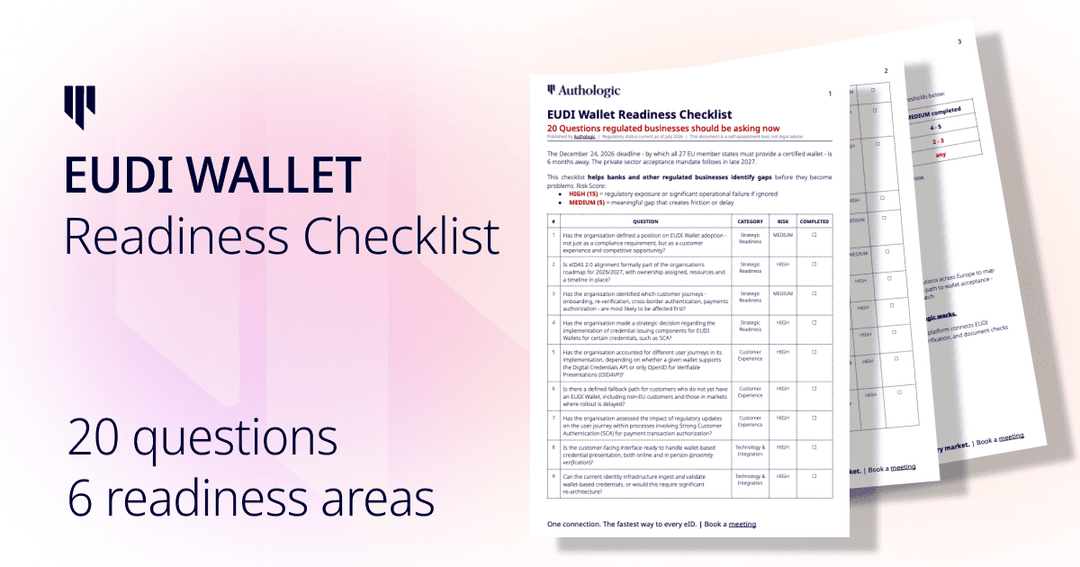
Not sure where your organisation stands?
Download 20 questions that help banks identify gaps before the December 2027 acceptance mandate kicks in.
Download figures are published by the Danish Agency for Digital Government (Digitaliseringsstyrelsen), reported July 23, 2026. Daily download estimates are from SimilarWeb, unified metrics, July 2026, with partial June data, downloaded August 1, 2026; SimilarWeb figures are panel-based estimates and should be treated as directional rather than official statistics. MitID app usage figures are SimilarWeb estimates, unified metrics, June 2023 - June 2026. MitID registration figures are from the Danish Agency for Digital Government. Roadmap statements are from the agency's eID and apps division as reported by TV 2 and Kristeligt Dagblad on July 23, 2026.
Changelog
- August 1, 2026 - Added AltID adoption data through July 2026, the health insurance card and driving licence roadmap, certification status clarification, and FAQ.
- June 12, 2026 - Initial publication.
Share article
Press Contacts
Dominika Cepek
dominika.cepek@authologic.comAuthologic
contact@authologic.com